
A friend of mine from Finland and I were reminiscing about the Moomins. We both grew up watching them. For him, it was in Finnish. For me, it was dubbed in Arabic and sometimes English, playing on satellite TV in Kuwait while the world outside shifted in ways I barely understood.
If you’ve never seen it, the Moomins were strange. Gentle. Whimsical. Somewhere between a hippo and a daydream. A family living in Moominvalley, navigating seasons, creatures, and questions about who they were and where they belonged. No villains. No flashy resolutions. Just quiet persistence.
As a child, I didn’t understand why it moved me.
I do now.
A few days ago, that same friend shared an article with me that shook something loose. It was by Frances Wilson for the New Statesman, titled “The dark side of the Moomins.” It’s a piece that reframes everything I thought I knew about those little creatures.
Turns out, they were never meant to be just cute.
Tove Jansson, the Finnish artist and author behind the Moomins, wrote the first book during the 1939 Winter War between Finland and Russia. The Moomins and the Great Flood isn’t just a fantasy. It’s about displacement. About fleeing. About the search for a safe place to sleep. It mirrors the fear and dislocation of a country at war. It also mirrored something I carried as a child… without having words for it.
At age five, I survived the Gulf War in Kuwait. I don’t remember it like a documentary. I remember it like fragments. Closed curtains. Whispered worries. A bag packed by the door. My mother’s body positioned between us and the windows. No fireworks. Just silence and a deep, echoing uncertainty.
When I watched the Moomins, I was watching something familiar in disguise. Creatures trying to stay together. Looking for home. Surviving winter, not just weather. Characters who didn’t fight but endured. Who didn’t win but stayed kind.
Wilson’s article dives deeper. Jansson didn’t want to be a mascot. She was frustrated by how commercialised the Moomins became. She was an artist torn between worlds. A queer woman navigating post-war Europe. Someone who used softness to speak about hard things.
She drew her Moomins small, under towering trees. Always slightly off-centre. Always a little unsure. She understood the feeling of being lost, even when you’re at home. And she knew that comfort isn’t always a warm blanket. Sometimes it’s a story that quietly says, “You’re not the only one who’s scared.”
Reading Wilson’s piece hit me harder than I expected.
Because while I survived a war, I also survived the questions that followed. Where are we going? Are we safe? Will we ever go back? And in those questions, the Moomins weren’t cartoons. They were companions. They were how I learned that fear doesn’t make you weak. It makes you human.
Legacy doesn’t always come in loud, glorious form. Sometimes it comes in the shape of a Moomintroll wandering through a dark forest, holding onto his mother’s hand.
So here’s to Jansson. To the Moomins. To the quiet power of stories that understand what we go through before we do.
And to every child, past or present, who needed that kind of story to survive.
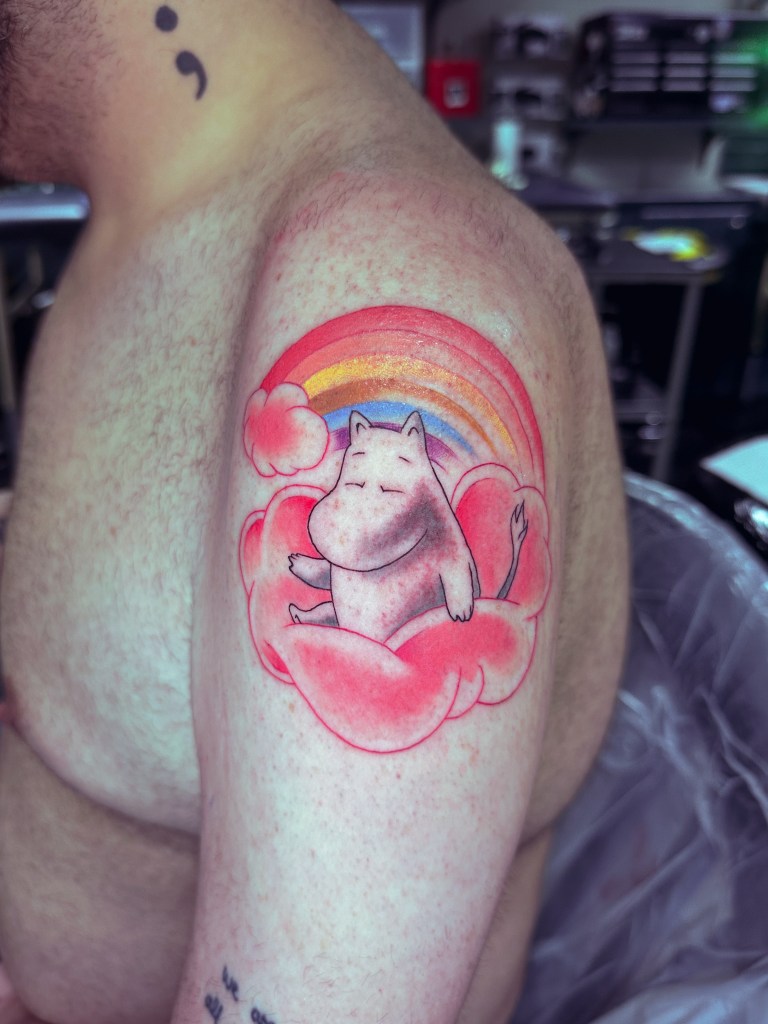
Rate my Moomins tattoo please from “awesome” to “omg I love it”!
 Moey writes here.
Leave a comment